
In the increasingly nuanced world of residential extensions, where heritage sensitivity must coexist with contemporary expression, The Double Glazed House by Between Art and Technology Studio stands out as a compelling case study in material intelligence and design rigour. Located in north-east London, this ambitious renovation and extension of a substantial Victorian property demonstrates how clay brick, one of the most familiar construction materials, can be reimagined as both a technical and sculptural medium.
At its core, the project is an exploration of handmade glazed brickwork and the tactile qualities it can bring to domestic architecture. Rather than treating brick as a background element, the studio elevates it to the primary architectural language. The result is a dialogue between historic craftsmanship and contemporary precision, one that feels both grounded and forward-looking.
Material as Form: The Monolithic Green Volume
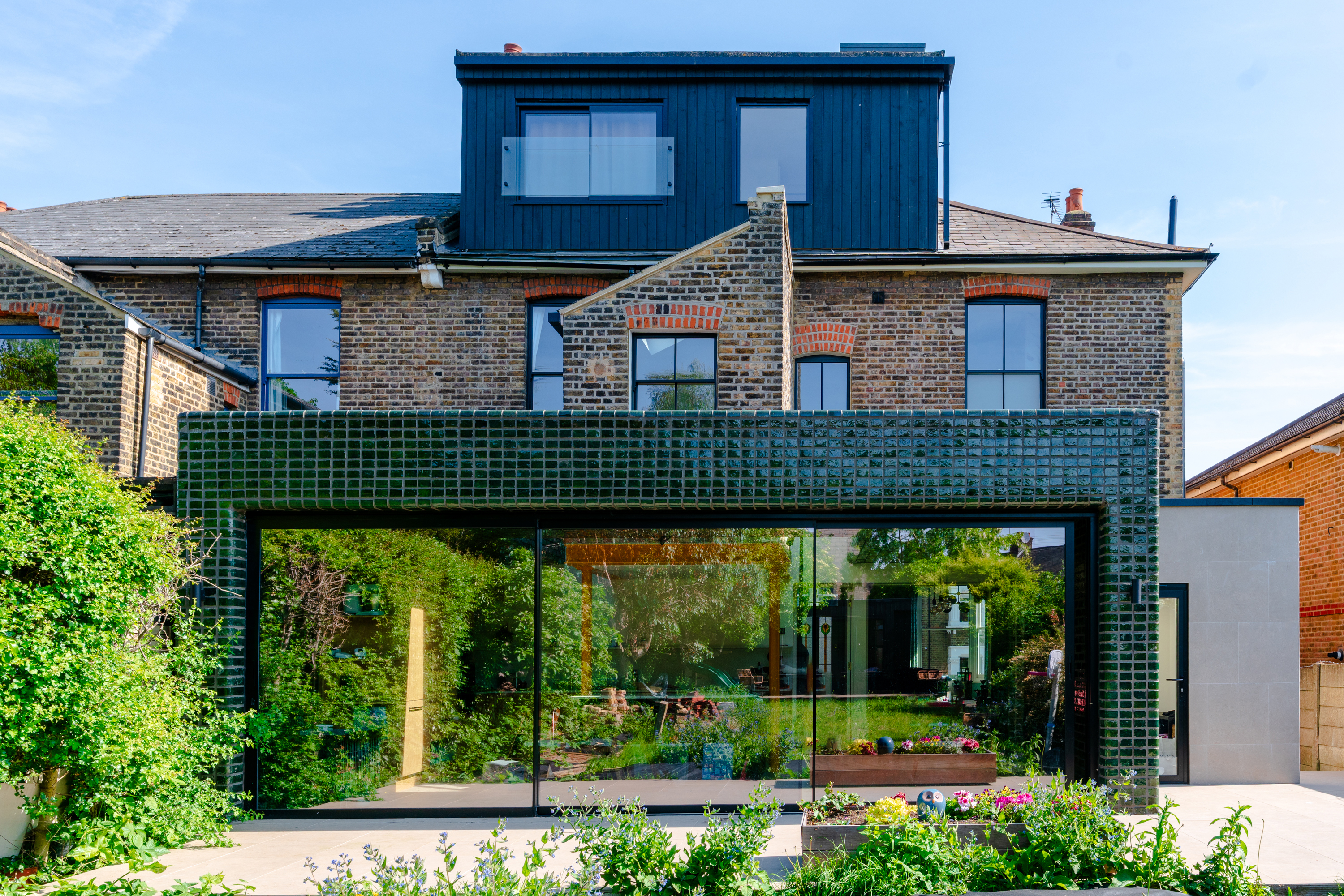
The most striking gesture is the green-glazed brick mass that anchors the extension. Developed in close collaboration with HG Matthews, this volume is conceived as a singular, monolithic form into which openings are carefully carved. The design avoids fragmentation; instead, it relies on disciplined alignment and meticulous construction to achieve clarity and presence.
A mixture of full bricks and brick slips was employed throughout, allowing the architects to maintain visual and dimensional continuity across surfaces. This approach is particularly instructive for specifiers and developers seeking to achieve material cohesion without sacrificing detailing flexibility. It demonstrates how combining standard components with slips can deliver both cost control and design precision when handled thoughtfully.
Orientation-Led Patterning
A notable design consideration lies in how the vertical surfaces respond to orientation. The north and south elevations are stack bonded, producing a strong vertical rhythm and a sense of ordered repetition. In contrast, the east and west elevations adopt stretcher bond, introducing a more familiar horizontal cadence.
This deliberate variation is subtle but powerful. It reinforces the monolithic identity of the form while preventing visual monotony. The approach also highlights how bond selection can be used as a design tool rather than simply a construction default, an insight particularly relevant for architects aiming to enrich façades without adding unnecessary complexity.
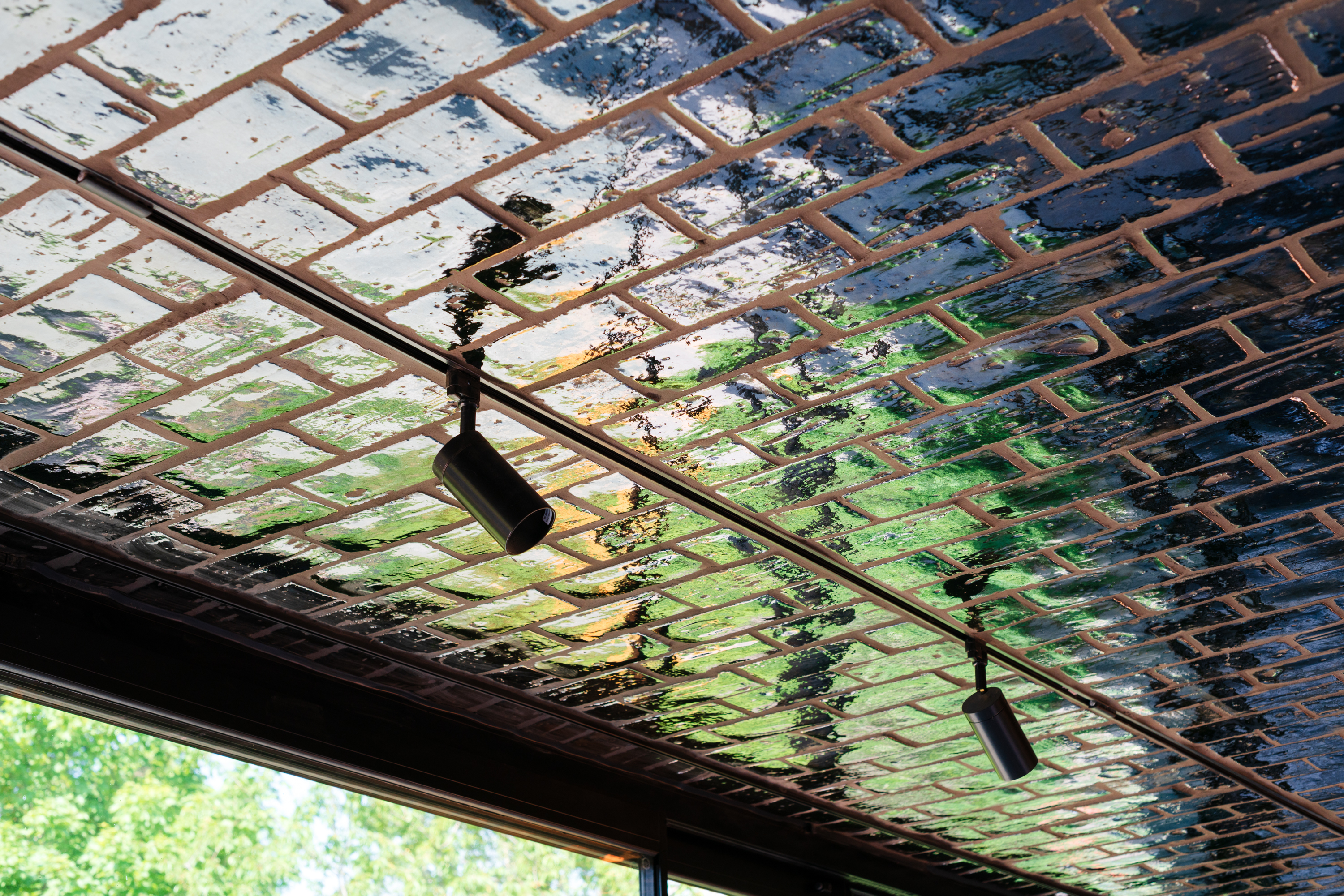
The same attention extends to the ceiling plane, which is lined with custom brick slips cut to the footprint of a brick base and laid in a continuous stack bond. Treating the soffit with equal design intent ensures the spatial experience is cohesive from every angle, an often overlooked but highly effective strategy in residential architecture.
Sculptural Detailing Through Bullnose Geometry
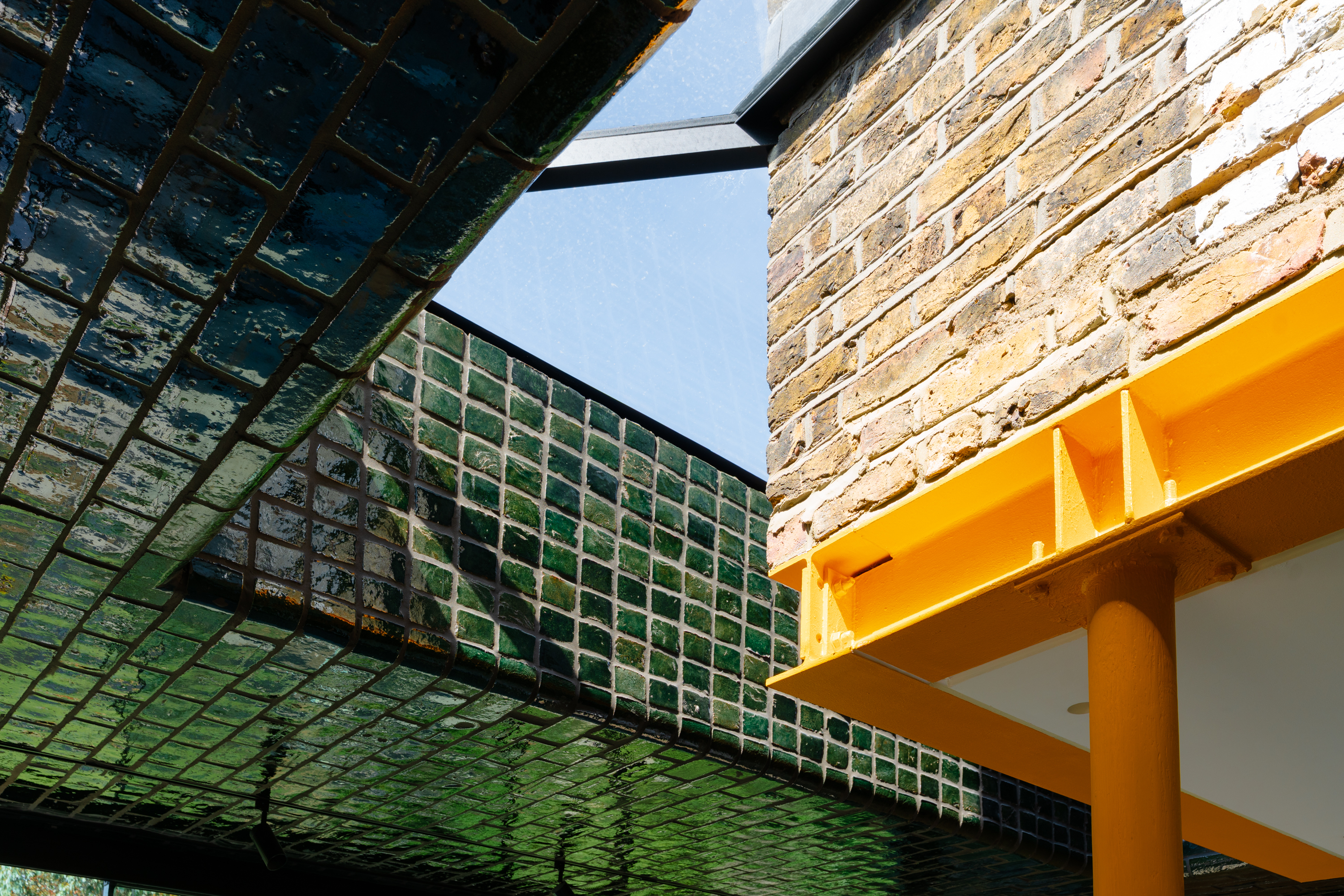
Corners and edges are frequently where architectural intent is either reinforced or diluted. In this project, 50 mm bullnose bricks are used to round every corner of the green volume. This single move softens the overall mass while simultaneously emphasising its sculptural quality. The gesture is economical yet expressive, a reminder that small dimensional shifts can have disproportionate visual impact.
To achieve curved returns on soffits, the team employed a suspended brick system more commonly associated with large-scale commercial projects. Full bricks are effectively hung upside down, enabling continuity of material and geometry where conventional methods would struggle. For developers and contractors, this illustrates how cross-sector construction techniques can unlock new formal possibilities in domestic schemes.
Bespoke Elements and Digital Craft
While most surfaces rely on standard bullnose variations, certain junctions required bespoke solutions. Rather than compromising the design, the studio utilised its in-house workshop and digital fabrication capabilities to produce custom moulds with 3D-printed inserts. These moulds enabled the casting of highly specific brick specials, seamlessly integrated into the wider palette.
This hybrid of handmade production and digital precision is particularly instructive. It demonstrates that bespoke does not necessarily mean inefficient; when strategically deployed, it can resolve complex conditions while preserving overall material logic.
Dialogue With the Existing Fabric
Equally important is how the extension relates to the original Victorian house. The design steps carefully away from the existing structure, retaining the first-floor outrigger, which is supported on slender yellow steel legs. This move allows the historic fabric to remain legible while introducing a contemporary intervention that is confident yet respectful.
The existing brickwork, with its added layer and irregularities, is preserved rather than concealed. The new glazed brick does not compete with it; instead, it establishes a conversation across time. For conservation-minded projects, this balance offers a persuasive model: contrast need not mean conflict when materiality is handled with sensitivity.
Collaboration as a Design Driver
The partnership between Between Art and Technology Studio and HG Matthews is not incidental. It is the product of a longstanding working relationship built through previous bespoke brick initiatives. The Double Glazed House can therefore be seen as the culmination of shared experimentation, technical trust, and a mutual commitment to craft.
For architects, specifiers, and developers alike, the project underscores the value of early and sustained collaboration with manufacturers. When suppliers are engaged as creative partners rather than late-stage vendors, material innovation becomes far more achievable.
The Double Glazed House ultimately demonstrates that design consideration is not confined to plan or elevation; it resides equally in surface, joint, corner, and collaboration. For those shaping the built environment, it is a vivid reminder that even the most familiar materials still hold vast, largely untapped expressive potential when approached with curiosity and technical care.
Brick Bulletin | Feature 282


