

Details
Location: Somerset
Brick Manufacturer: Northcot Brick
Brick Names: Grange Blend, Bourton Manor Handmade
Architect: Purcell Architects
Brickwork Contractor: A.Willmott Brickwork
About the project
The Shoemakers Museum
The Alfred Gillett Trust approached this project with a clear and consistent position: every pound in a modest budget had to deliver genuine environmental value. Guided by Quaker values, the Trust had no interest in targets and certifications for their own sake. The ambition was a building of enduring quality, tested against rigorous methodology, designed to last.
Design and Materials
Passive House Planning Package modelling was run from Stage 1, benchmarking fabric performance in real time and informing decisions as they were made rather than validating them after the fact.
The starting point was radical reuse. Rather than treating the failing 1980s link building as waste, over 70% of its blue lias stone was salvaged and each piece redressed on site for reuse in the new construction. Existing concrete slabs were retained wherever structurally viable, avoiding unnecessary demolition and the embodied carbon it entails.
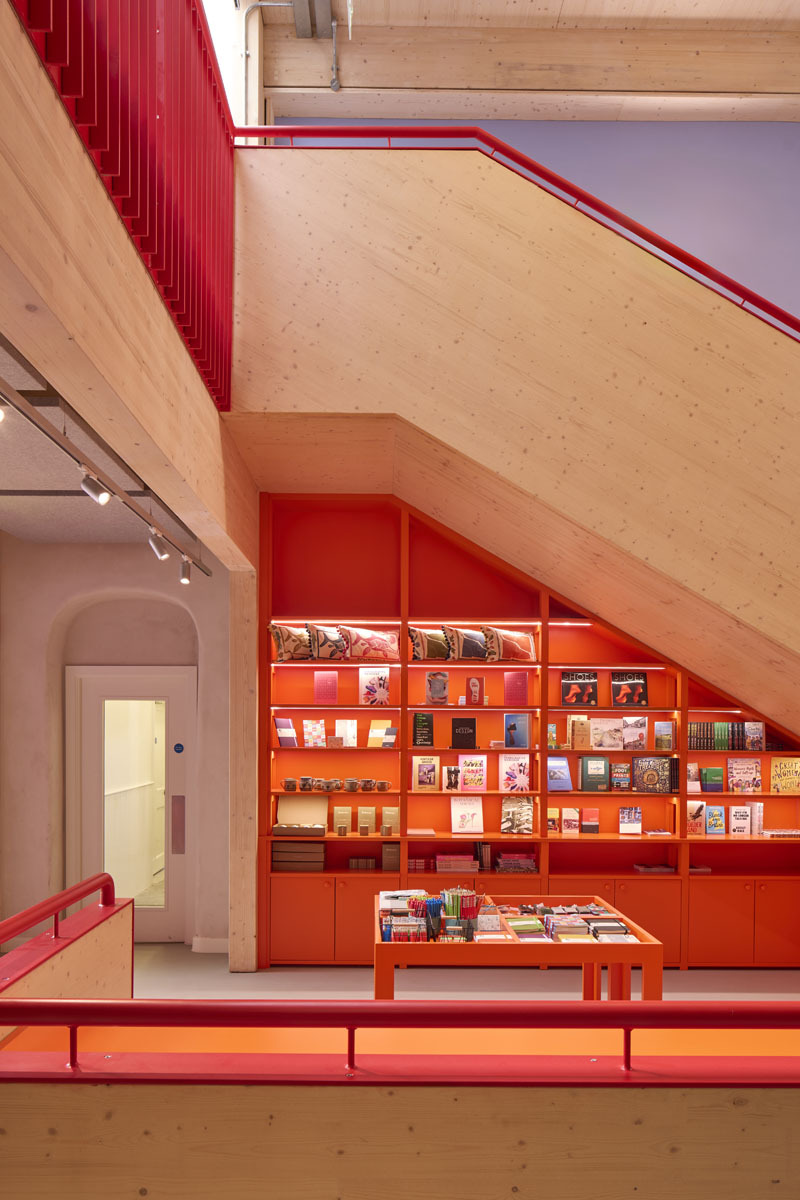
The structural frame is cross-laminated timber with glulam columns and beams, sourced from the UK's sole glulam supplier and from Austrian certified sustainable forestry. The timber concrete composite floor system, potentially a first application in the UK, uses a thin in-situ concrete topping acting compositely with the CLT deck, achieving spans of 9.5 metres against the 7.5 metres standard CLT alone could deliver. Enhanced acoustic performance and inherent fire resistance were achieved without significant additional embodied carbon. Upfront embodied carbon at A1-5 was recorded at 212 kgCO2eq/m2, with a whole-life embodied carbon of 352 kgCO2eq/m2.
Fabric Performance
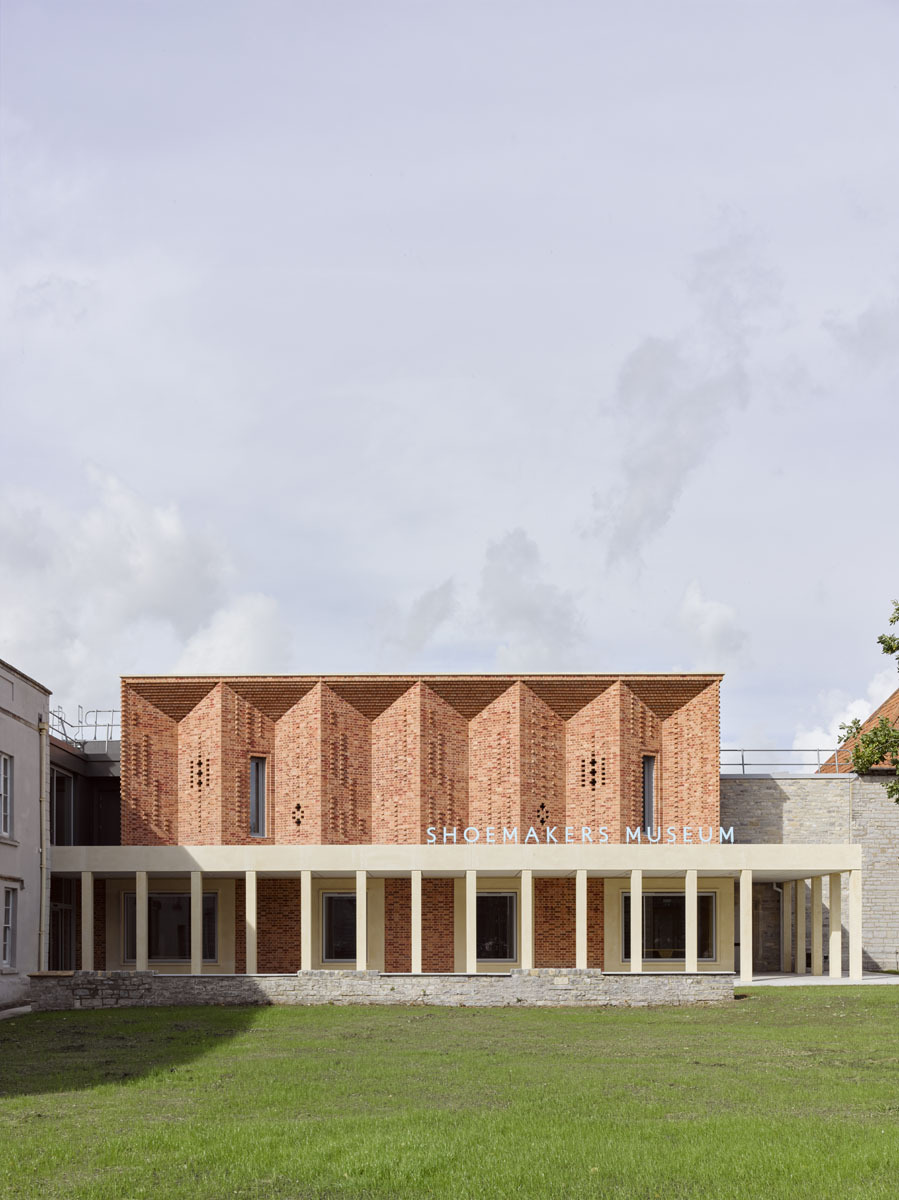
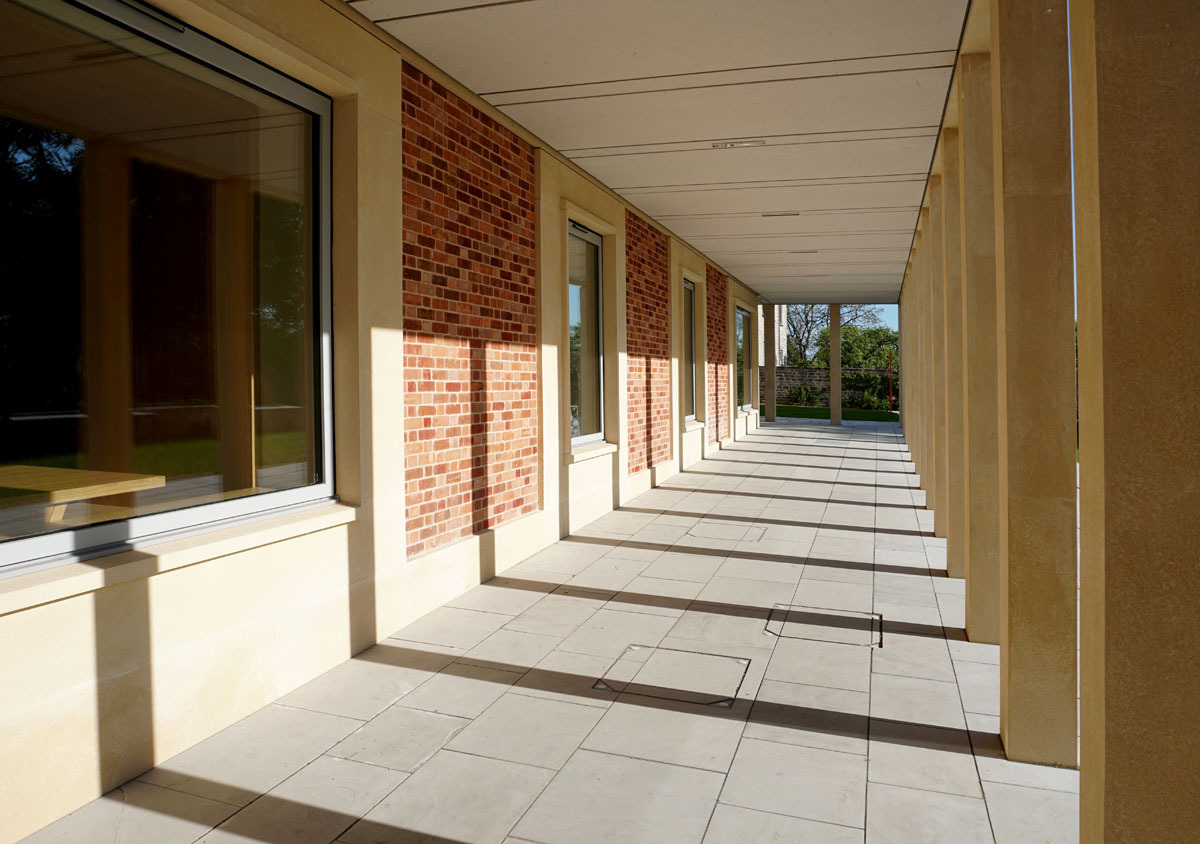
All brickwork is set in NHL 3.5 lime mortar, enabling complete disassembly and reuse at end of life. Only 13 brick types were specified, all from the British Standard range, eliminating the need for custom manufacture, avoiding obsolete components and producing no waste.
The overall area-weighted U-value achieved is 0.16 W/m2K, with an airtightness of 3.56 m3/h.m2 at 50Pa. Both figures reflect a fabric-first approach that prioritised genuine performance over regulatory compliance.
Local Suppliers
The supply chain was deliberately and consistently local. Northcot Brick in Gloucester supplied the bespoke Grange Blend. Blue lias was salvaged and redressed on site. Glulam was sourced from the UK's sole supplier. Bricklayers from A.Willmott Brickwork, a firm based in Street, executed the complex corbelled and perforated façade. Main contractor RIGG Construction, based in Wiltshire, delivered the project within a 16-month programme, demonstrating that genuine sustainability and exceptional quality are not premium propositions.
Building Operation
The building is fully electric in anticipation of the grid's long-term decarbonisation. A single integrated air-to-air system serves the galleries, providing heating, humidity control and mechanical heat recovery via a centralised AHU, with sensors maintaining the precise environmental conditions the collection requires.
The heating and hot water load is 10.79 kWh/m2/yr, with operational energy of 31.19 kWh/m2/yr and annual CO2 emissions of 1.2 kgCO2eq/m2. The PV array, increased from initial specification to 31 kWh through Stage 4 design development, provides 100% of the building's energy requirements at peak operation. Annual mains water consumption is 356 m3. The building achieves an EPC rating of A-3 and is designed for a 100-year life.
Whole Life Carbon
The life cycle carbon assessment was not a client requirement but a Purcell initiative, commissioned during construction as an independent measure of the sustainability principles embedded from the outset. It tested our convictions against a rigorous methodology. The result was LETI A, validating an approach built on material reuse, local sourcing, fabric-first design and all-electric low-carbon operation.
Community and Impact
The museum has created a civic anchor reconnecting Street with its industrial heritage, largely demolished in the late 1980s to make way for outlet retail. It provides a permanent home for a nationally significant collection, including ichthyosaur fossils unseen by the public for twenty years, and creates accessible cultural, educational and community spaces with step-free connections throughout and a lift to all floors, ensuring the building genuinely serves everyone it was built for.
Honest Sustainability
The Shoemakers Museum demonstrates that a modest budget, a client with deeply held values, and a practice committed to testing its own principles can produce a building that is genuinely, durably and honestly sustainable. Like the shoes it celebrates, quality without pretension, built to last, made properly.
Sponsored by Michelmersh Brick Holdings PLC

As Britain’s Brick Specialist, Michelmersh Brick Holdings PLC unites the best in clay traditions. The Group represents six recognised premium brands across the UK and Europe; Blockleys, Carlton, FabSpeed, Floren.be, Freshfield Lane, and Michelmersh, producing 120million clay bricks, pavers, special shaped bricks and prefabricated brick systems.
Using modernised production methods that emphasise sustainable and innovative building solutions, adhering to stringent production requirements, Michelmersh guarantees high-quality product standards with a low ecological footprint.
We lead the way in producing Britain’s premium clay products, enhancing our built environment, adding value to the architectural landscape for generations to come.


